
Swarm Intelligence -A Group Decision
Swarm intelligence uses diverse intelligence to analyze solutions to complex data
ARTIFICIAL INTELLIGENCEINTERNET OF THINGS
7/9/20264 min read
The Flaw of the Monolith
In the traditional tech era, we usually measure machine intelligence by pure horsepower: massive processor performance, blazing data speeds, and dense memory blocks. We are accustomed to treating AI as a single, standalone system—a massive central "brain" powering a web of dependent subsystems.
However, this monolithic architecture has a dangerous structural flaw: a single point of failure.
If the central brain goes offline, the entire network drops dead. Furthermore, when a unified intelligence tries to juggle countless localized tasks simultaneously, it hits severe data bottlenecks, leading to massive bandwidth congestion and high time consumption. To break this logjam, tech innovation had to look away from massive supercomputers and look toward nature.
Enter the Smart Swarm
Most of us use digital assistants like Alexa or Google Home to automate daily tasks, whether it’s setting a morning reminder or pulling up a recipe. But imagine if your smart home could think steps ahead. What if your digital assistant could autonomously sync with your smart refrigerator to manage your health goals—automatically tracking your nutrition, cross-referencing your grocery habits, and ordering refills for depleted items?
Historically, this level of teamwork was a pipe dream because different tech brands couldn't talk to each other. Today, thanks to unified smart home protocols like Matter, devices from entirely different vendors can speak the exact same local language. When we cross-link multiple low-voltage Internet of Things (IoT) devices into a single, collaborative mesh network, we unlock Swarm Intelligence.
The Biological Blueprint: Nature's Algorithm
To understand how this works, look at a colony of foraging ants. No single ant carries a blueprint of the forest. Instead, each ant takes an independent path, exploring the environment and tracking unique scent markers.
Ant A finds food ──► Lays down pheromone trail ──► Swarm locks in Ant B finds shortcut ──► Lays a stronger trail ──► Swarm dynamically re-routes
If Ant A discovers a picnic basket, it leaves a chemical trail of pheromones. The rest of the colony locks onto that trail, forming a unified supply chain. However, if Ant B discovers a shorter, more efficient shortcut, the group doesn't stubbornly stick to the old layout. They adapt on the fly, dynamically shifting their collective behavior to follow the optimized route. Intelligence stops being a top-down command and becomes a horizontal group effort to reach a solution.
The Wisdom of the Crowd
You can see this exact mathematical phenomenon in human behavior. Imagine placing a large jar of ping-pong balls on a table and asking a single observer to guess the total without counting them. If the real number is 60, a lone individual might guess 50—leaving an error margin of 10.
But what happens if you ask 10 different people and average their guesses?
Individual biases and wild anomalies naturally cancel each other out. The crowd's collective average will inevitably hover around 55, shrinking the error margin to just 5 and drastically increasing the accuracy of the prediction.
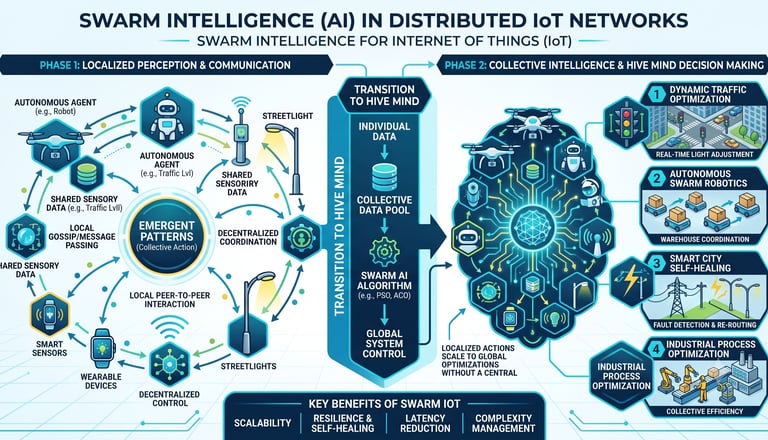
By applying this exact "Wisdom of the Crowd" logic to IoT—where thousands of tiny, inexpensive sensors gossip, share telemetry, and vote on localized decisions—we create systems that are highly scalable, incredibly fast, and completely immune to a single point of failure.
The Engine of the Swarm: Artificial Swarm Intelligence (ASI)
In computer science, this collective architecture is formally known as Artificial Swarm Intelligence (ASI). By definition, ASI is a decentralized, self-organizing system—meaning it requires no central supervisor to dictate commands.
This framework is perfectly tailored for the modern Internet of Things (IoT). Your home is already packed with clusters of low-power, localized devices: smart thermostats, automated lighting systems, burglar alarms, ambient digital monitors, and smart speakers. Under ASI, these isolated gadgets stop acting like individual components and start acting like a unified team.
[Presence Sensor] ──► (No footsteps detected) ──► [Smart Speaker Hub] │ ▼ [User Notified via Mobile] ◄─── [Smart Lights Dimmed Automatically]
Consider a real-world scenario: You rush out the door for work and forget to turn off the bedroom lights. Instead of leaving them on all day, a smart motion or footprint sensor notes the prolonged absence of activity. It gossips this information to your smart speaker, which automatically commands the lighting grid to drop into an eco-friendly dim mode while sending a quick status confirmation to your smartphone.
Under the Hood: Parallelism & GPU-Driven Logic
Beneath this seamless orchestration lies a highly parallelized algorithmic framework.
To understand why traditional processors struggle with this, look at standard microprocessors like the x86 architectures (Intel or AMD). These CPUs are built like master craftsmen: they execute complex tasks sequentially (one after the other) with hyper-precision, but they easily bottleneck when forced to manage thousands of data streams at once.
Swarm AI, however, thrives on Graphics Processing Unit (GPU) logic and massively parallel architectures:
Thread-Level Parallelism: Think of it like a high-end video rendering engine. Instead of a single core rendering an entire image frame row-by-row, a GPU splits the image into thousands of micro-sections, assigning a dedicated computing "thread" to render each part simultaneously.
Dynamic Convergence: In an ASI network, these parallel threads aren't isolated; they communicate at precise hardware intervals. If one thread discovers an optimized computational path or finishes its localized task early, it alerts the rest of the mesh. The neighboring threads instantly adapt, shifting their processing weight to execute the remaining workload along the newly discovered path.
By replacing slow, top-down processing with blazing-fast parallel teamwork, ASI turns cheap, low-power IoT hardware into a hyper-responsive ecosystem.