
Security in a Cloud Based EcoSystem
Protecting Internet of Things devices
INTERNET OF THINGSCYBER SECURITYCYBER CRIME
Jeugene John V
3/15/20263 min read


The rise of Internet of Things (IoT)
Over the past decade, we have witnessed a relentless wave of technological innovation, moving from the ubiquity of smartphones to the current frontiers of Artificial Intelligence. Rarely in history has such a short interval produced so many transformative breakthroughs. Among these, the rise of "Smart" consumer devices—technically known as the Internet of Things (IoT)—stands out as a pivotal shift in how we interact with our environment.
IoT is an umbrella term covering a vast array of devices that do more than just perform routine tasks like lighting, washing, or securing a home. Unlike the "dumb" devices of previous generations, these systems can analyze user preferences and adjust their parameters autonomously. This transition from reactive to proactive technology represents a significant leap in engineering.
Take, for example, a smart lighting system. Instead of waiting for a manual switch, the system can monitor a room using infrared sensors or motion detection to manage energy efficiency without human intervention. Similarly, smart locks represent a total departure from the traditional "key and bolt" model. By leveraging Bluetooth communication between the lock and the owner's smartphone, these devices can recognize the user’s proximity and grant access automatically. This is the new standard of a connected, intelligent world.
The Cyber Security Challenge
As established, the true power of these devices lies in their connectivity to the grid or the internet. This connection allows for the sophisticated processing and analysis of data using AI, while local storage ensures faster access and responsiveness. However, this same connectivity creates a significant vulnerability. For a hacker, an unsecured IoT device is a treasure trove of information, offering insights into user preferences or, more alarmingly, direct access to personal hardware like home security cameras. This represents a serious breach of privacy and safety, making robust security protocols an absolute necessity rather than an afterthought.
The Defense Mesh
Hardware Security Module (HSM) is a built-in cryptographic processor dedicated to the secure storage of passwords, public keys, and other sensitive credentials. The primary purpose of this hardware is to isolate critical data from unauthorized access or "prying eyes." It achieves this by managing the entire lifecycle of cryptographic keys—generating, activating, authenticating, and validating them within a secure environment. The keys generated within an HSM are based on robust public-key and symmetric algorithms, including RSA, DSA, ECDSA, AES, and Triple-DES. To ensure maximum security, the processor is encased in a tamper-resistant and tamper-proof shell, with all sensitive data stored locally on the silicon. Furthermore, modern implementations often incorporate a dedicated hardware firewall as an additional layer of protection, creating an uncompromising "Defense Mesh" at the device level.
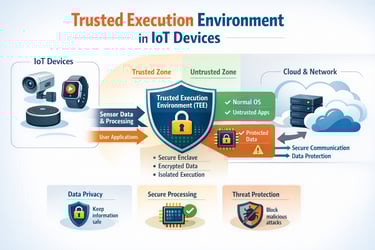
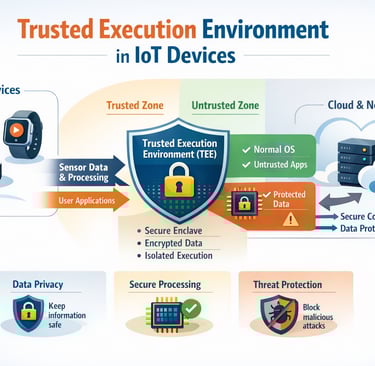
Trusted Execution Environment (TEE) is a highly secure area of the main processor where critical operations are performed in total isolation from the primary Operating System. Access to this environment requires specific, separate privileges, ensuring a "Root of Trust" that remains unaffected even if the main OS is compromised. Applications running within this secure environment are known as Trusted Applications (TA). Every TA must be digitally signed and authorized by a trusted entity—typically the device manufacturer—who is, in turn, audited by governmental or international standard-setting agencies. If a Trusted Application fails to meet these rigorous security requirements, it is immediately revoked or deleted by the system.
Furthermore, the TEE enforces strict resource isolation: one TA cannot access the data or files of another. For instance, if "TA1" and "TA2" both create a file named "password," the TEE treats them as entirely separate, distinct entities. Each TA operates within its own individual "sandbox," or container, ensuring it possesses only the minimum privileges required for its specific task. This architecture makes brute-force attacks effectively impossible, as any hardware tampering or integrity violation results in a complete lock down of the secure OS.
Conclusion
While the Internet of Things is a relatively new entrant to the global technological arena, it is maturing rapidly. As more standardized protocols and rigorous security benchmarks are developed, the "smart" landscape will continue to shift toward a more robust and resilient environment. By implementing device-level defenses like HSMs and TEEs today, we are not just building smarter systems—we are building a foundation of trust for the future of connected engineering.