

Nvidia Jetson - The New Entry in GenAI
Nvidia provides its latest generation of modules and development kit for Gen AI, Computer Vision and Robotics
ARTIFICIAL INTELLIGENCEINTERNET OF THINGS
Jeugene John V
4/1/20263 min read
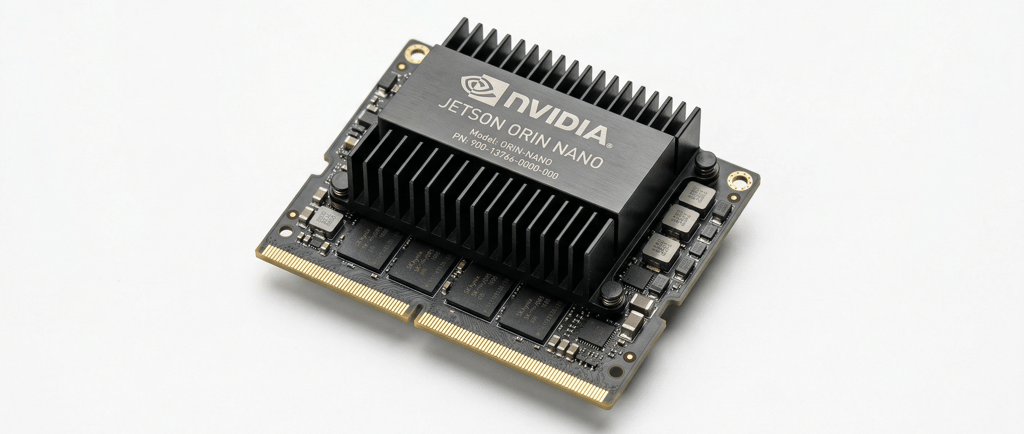
The Powerhouse: The Industrial Evolution of Edge AI
Artificial Intelligence (AI) has transitioned from cloud-based clusters to the very "edge" of our physical world. We see this integration everywhere—from consumer electronics like smart microwaves, televisions, and doorbells to industrial-grade robotics, conveyor systems, and intelligent fire alarms. The strategic benefits of these smart devices—enhanced performance and real-time productivity—far outweigh the implementation costs.
The hardware landscape powering this revolution is expanding rapidly. Established leaders like Raspberry Pi and Espressif (ESP32) continue to define the IoT space, while Arduino—now bolstered by a strategic partnership with Qualcomm—is pushing into high-performance industrial modules. These solutions range from "ready-to-use" development kits to complex System-on-Chip (SoC) architectures.
However, the "performance ceiling" has been shattered by the NVIDIA Jetson series. By delivering up to 275 TOPS (Trillion Operations per Second) and massive bandwidth, NVIDIA has brought data-center-class AI directly to the edge, enabling a level of autonomy that was previously impossible.
NVIDIA JETSON NANO
Capable in tech frontiers though smaller in dimension

The Edge Advantage: Privacy, Latency, and Power
"Edge AI" has become the definitive pulse of the modern tech sphere. Traditionally, data was collected by edge devices and transferred to remote cloud servers for processing, creating a "round-trip" delay. With the rise of Edge AI, data is processed locally, directly on the hardware. This shift effectively mitigates critical cloud-based drawbacks, specifically data privacy and latency issues caused by unstable or high-latency network connections.
A key driver of this transition is the jump in raw compute power. Current entry-level modules, such as the NVIDIA Jetson Orin Nano, provide up to 40 TOPS (Trillion Operations per Second), while top-tier AGX Orin modules reach a staggering 275 TOPS. This is more than sufficient for sophisticated applications like real-time Computer Vision and Generative AI (GenAI) at the edge.
Furthermore, the global 2026 memory shortage—driven by the massive redirection of manufacturing toward AI-server High Bandwidth Memory (HBM)—has disrupted traditional supply chains. This challenge is uniquely addressed by the System-on-Chip (SoC) and Unified Memory Architecture found in the Jetson series. By integrating high-speed LPDDR5 memory directly onto the module, these systems eliminate the "bottleneck" of data traveling between a separate CPU and RAM, significantly increasing read/write speeds.
Finally, the development kits come equipped with the JetPack SDK, which includes pre-trained AI models and optimized "topologies." This provides engineers with a "ready-to-deploy" framework for complex neural network integration, reducing time-to-market for the next generation of autonomous machines.
Navigating the Architecture: From Xavier to Thor
The NVIDIA Jetson lineup is diverse, spanning multiple generations and performance tiers. While it is impossible to detail every sub-variant here, the ecosystem is currently defined by three primary architectures: Xavier (the established industrial legacy), Orin (the current high-performance standard), and the upcoming Thor (designed for next-generation centralized automotive and robotic intelligence).
While Xavier remains prevalent in existing industrial deployments, Orin is the current focus for developers due to its superior efficiency-to-cost ratio. The flagship of this series, the Jetson AGX Orin, is offered in two primary configurations defined by their memory capacity: a 32 GB entry-level model and a 64 GB top-tier powerhouse.
For the 32 GB AGX Orin, the technical specifications are formidable:
CPU: An 8-core Arm® Cortex®-A78AE v8.2 64-bit processor with 2 MB of L2 cache and 4 MB of L3 cache, clocked at a maximum of 2.2 GHz.
GPU: Based on the NVIDIA Ampere architecture, featuring 1792 CUDA cores and 56 third-generation Tensor Cores (providing specialized hardware acceleration for AI inference).
Memory: 32 GB of 256-bit LPDDR5 unified memory, offering a bandwidth of 204.8 GB/s.
I/O & Power: The module supports high-speed connectivity via USB 3.2 and USB-C, with a configurable power envelope capped at 40 W.
Conclusion: The Edge of Autonomy
The shift from cloud-centric processing to Edge AI represents more than just a reduction in latency; it is a fundamental re-architecting of how intelligence is distributed across the physical world. As we have seen, the NVIDIA Jetson Orin series—with its transition to the Ampere architecture and Unified Memory—has effectively shattered the performance ceiling for embedded systems.
Whether it is an entry-level Orin Nano providing 40 TOPS for a smart camera or an AGX Orin delivering a staggering 275 TOPS for an autonomous robotic fleet, the technology is now mature enough to handle high-fidelity GenAI and complex Computer Vision without a safety net from the cloud.
For engineers navigating the Three Pillars of AI, ML, and IoT, the Orin family is the current "Sweet Spot" of efficiency, cost, and raw power. While the horizon holds the promise of the Thor architecture and even higher-density compute, the tools available today are more than sufficient to build the "High-Frequency" autonomous systems of tomorrow. The revolution is no longer coming; it is already running at the edge.