

Gemini Nano - AI in your hands
Gemini Nano is the tech that brings AI to the mass. It provides easy to use interface, high security and low latency. A combination to speed up the future
ARTIFICIAL INTELLIGENCEINTERNET OF THINGSCYBER SECURITYCYBER CRIME
6/25/20262 min read
The Privacy Paradox: Why Your AI Should Stay on Your Phone
Artificial Intelligence is the defining buzzword of our era. From medicine to finance, AI is revolutionizing how we handle complex tasks—turning hours of manual labor into mere seconds of computation. But this revolution carries a hidden cost: Security.
The Cloud Problem
Most modern "smart" applications rely on a cloud-based architecture. When you interact with an AI feature, your data is packaged, sent to a remote server, processed, and then sent back to your device.
While this is convenient, it presents two major concerns:
Privacy Invasion: Sensitive personal data often leaves your device and traverses the internet. Even with standard EULA protections, your data is exposed to potential breaches during transit or at the server level.
Latency: Sending data to the cloud introduces an unavoidable delay—the time it takes for information to travel to a server and back.
Why not just process everything on the device?
Historically, Large Language Models (LLMs) were too "heavy." They required massive memory footprints and high-end hardware acceleration that the average consumer device simply couldn't handle. The industry remained stuck in a cycle of "Cloud-or-Bust."
Enter Gemini Nano: AI at the Edge
Google has fundamentally shifted this paradigm with Gemini Nano. Instead of forcing apps to carry the weight of an entire AI model, Google introduced a more efficient way to handle on-device intelligence.
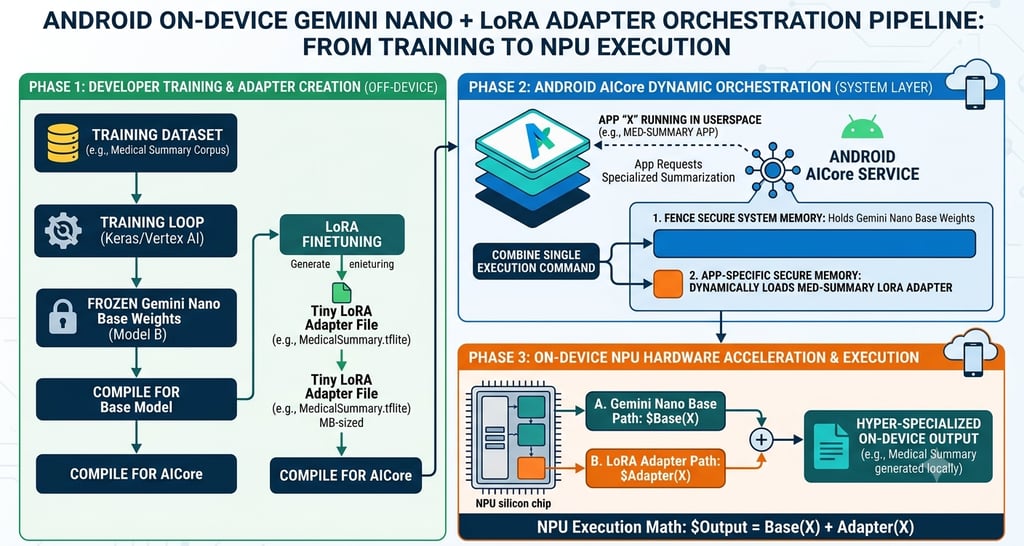
The Technical Breakthrough: Android AICore
The secret isn't just the model—it’s how it’s delivered. Google built a system-level service called AICore into the Android operating system.
Shared Intelligence: Instead of every individual app "owning" a massive AI model, apps tap into the centralized AICore service already present on the device. This saves massive amounts of storage space.
Hardware Optimization: AICore leverages the device’s specialized hardware—such as the NPU (Neural Processing Unit) or TPU (Tensor Processing Unit)—to run "quantized" models. By using techniques like weight pruning and mixed-precision math, Google has shrunk the model size without sacrificing the logic required for tasks like text summarization, grammar correction, or smart replies.
Low-Rank Adaptation (LoRA): For developers who need specific tasks handled, they can use "LoRA adapters." These are tiny, lightweight modules that "fine-tune" the base Gemini Nano model for a specific app’s needs without requiring a full, heavy model update.
The Result: A "Privacy-First" Future
By moving inference (the process of "thinking") from the cloud to the silicon inside your phone, Gemini Nano achieves three things:
Total Privacy: Your data never leaves the "vault" of your device.
Offline Functionality: Because the model lives on your hardware, features work without a network connection.
Instant Response: Without the "round-trip" time to a cloud server, the latency is slashed to milliseconds.
The era of the "smart" device is evolving into the era of the "intelligent" device—one that thinks for itself, right in your pocket.