

Beyond the Frame: The Dawn of Neuromorphic Surveillance
New light sensors capture only the required information reducing latency and increasing informational data. This helps for high speed data recognition using Machine Learning
INTERNET OF THINGSARTIFICIAL INTELLIGENCECYBER CRIMECYBER SECURITY
7/1/20264 min read
The Old Era: The Burden of the Frame
When we think of modern surveillance and security, Closed-Circuit Television (CCTV) immediately comes to mind. These traditional video-capturing devices stream and record continuous footage for real-time monitoring or forensic review.
However, standard cameras operate under a massive hidden drawback: temporal redundancy.
Every single second, a standard CCTV camera blindly captures up to 60 full frames of video. If a camera is monitoring an empty hallway or a locked warehouse overnight, it still captures 60 images a second of absolute stillness. This creates a mountain of obsolete data that chokes storage drives, spikes power consumption, and introduces severe latency bottlenecks—especially when trying to stream massive video files over a cloud network.
Enter the Remedy: The Silicon Retina
To solve this, hardware engineers have developed a completely different breed of optical intelligence: Event-Based Vision Sensors (EVS).
Instead of forcing a rigid shutter to capture arbitrary frames, these sensors completely ditch the concept of frame rates. An event-based sensor remains in absolute digital silence until it detects a change in light intensity.
Traditional CCTV: [Frame 1] ──► [Frame 2 (Identical)] ──► [Frame 3 (Identical)] (Bloated Data) Event-Based EVS: [Silence] ──► [Silence] ──► [💡 LIGHT CHANGE!] (Sparse Data)
By only transmitting data when an active change occurs, the system slashes data volume by up to 100×. This results in ultra-low latency, blazing-fast processing speeds, and minimal power consumption.
The Biological Blueprint: Mirroring the Human Eye
Event-based vision operates on the exact same principles as human biology. Our eyes do not perceive the world in frame rates.
When light hits the photoreceptor cells (rods and cones) in your retina, your nervous system doesn't constantly re-map static objects like a blank wall. Instead, it processes localized transitions between light and dark shades. This sharp change is converted into an electrical impulse (a spike) and sent directly to the visual cortex via ganglion cells for instantaneous processing.
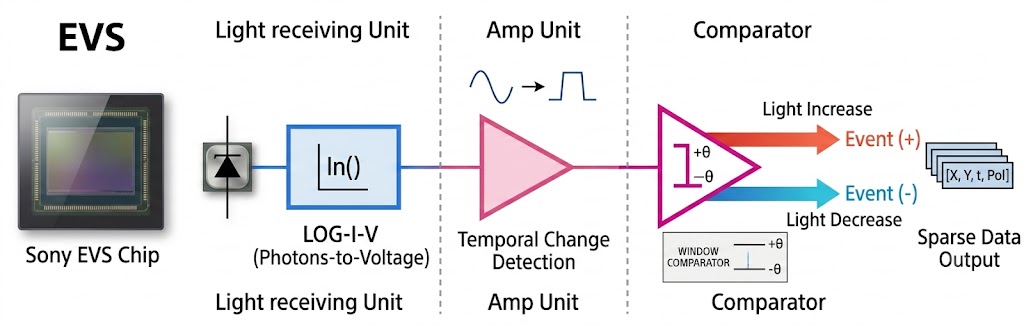
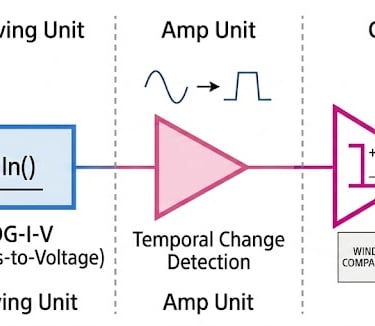
In our hardware sensors, this biological path is perfectly mirrored: when light hits the receptor, the analog signal is transferred directly to an internal amplifier circuit. This modulated signal is then evaluated by a high-speed comparator unit, which dynamically analyzes positive and negative changes to instantly deliver a clean data output.
Thresholding and Filtration: The Gatekeepers of Efficiency
A common misconception is that a neuromorphic sensor generates an output the exact instant photons hit the lens. However, doing so would flood the system with continuous analog noise, creating the exact same data bottlenecks we see in traditional CCTV. The remedy would become the problem.
To outmaneuver this data overflow, the internal comparator enforces a strict thresholding mechanism:
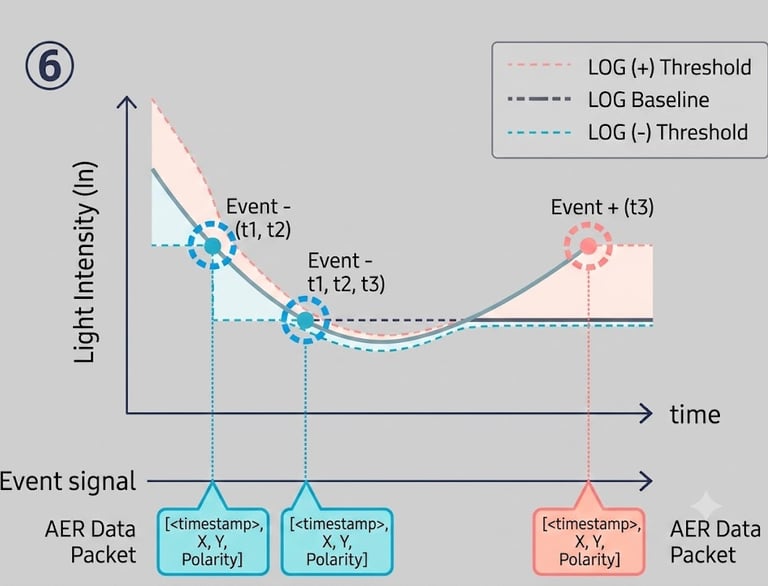
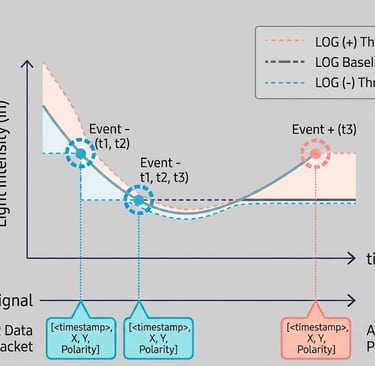
The Guardrails: The comparator establishes both an upper positive threshold (+theta) and a lower negative threshold (- theta). A pixel remains completely silent unless the incoming voltage drifts past these boundaries due to a distinct shift in light intensity
Dynamic Adaptation: The baseline reference voltage isn't fixed in stone. When the camera is moved to a completely different location or facing changing weather, the threshold baseline dynamically recalibrates to match the new environmental conditions. This adaptive tuning prevents the system from accidentally discarding vital data in low-light scenarios or generating noise in overly bright environments.
The Asynchronous Pipeline: First-In, First-Out (FIFO)
Unlike traditional cameras where all pixels are forced to report their data simultaneously at a fixed frame rate, an event-based sensor transmits data asynchronously.
Because each individual pixel fires entirely independently based on real-world movement, two neighboring pixels will have completely different time constants for their data outputs.
To keep this chaotic, self-triggered rush of microsecond data organized, the final processing backplane utilizes a First-In, First-Out (FIFO) buffer architecture:
Collision Prevention: Data packets are queued, timestamped, and routed in the precise chronological order they were generated.
Data Integrity: This ensures that high-speed motion across the sensor matrix never causes data congestion, packet collisions, or lost telemetry.
Real-World Applications: Transforming Industry & Privacy
The unique combination of microsecond latency and sparse data formatting makes neuromorphic sensing a disruptive force across multiple bleeding-edge industries:
1. Advanced Robotics & Autonomous Navigation
As industrial robotic automation shifts rapidly into the consumer and logistics sectors, fast spatial awareness is critical. Traditional cameras suffer from motion blur during high-speed maneuvers, which can lead to catastrophic obstacle collisions.
The EVS Advantage: Because event-based vision eliminates frames, it delivers crisp, blur-free edge contours of moving objects in microsecond timeframes.
High-Speed Execution: This feeds low-latency control loops directly into the robot's actuators, allowing for faster decision-making, hyper-precise path planning, and instant collision avoidance than conventional computing methods allow.
2. Predictive Machine Fault Detection
In heavy machinery and manufacturing plants, mechanical wear and tear is an expensive inevitability. Even a microscopic misalignment or a cracked bearing can halt an entire production line if left unchecked.
The EVS Advantage: Event-based cameras can capture sub-millisecond vibrational frequencies and micro-motions that are completely invisible to standard 60 FPS cameras.
AI Integration: When paired with machine learning classification models, the system continuously analyzes these high-frequency pixel fluctuations, accurately pinpointing an unbalanced component or structural anomaly long before a physical breakdown occurs.
3. Privacy-by-Design Public Surveillance
Deploying traditional surveillance networks in highly populated public spaces like metro stations, airports, or shopping malls consistently sparks massive ethical and privacy concerns. Citizens are understandably uncomfortable with centralized databases recording and archiving high-resolution footage of their faces.
The EVS Advantage: Neuromorphic sensors offer an elegant, structural solution to this dilemma. Because they do not capture color, texture, or static facial features—only the sparse, abstract coordinate paths of motion—they naturally anonymize the data at the hardware level.
The Result: Security systems can track foot traffic, analyze crowd density, or detect a slip-and-fall incident in real time without ever capturing identifiable personal imagery. It is security without profiling.