

Arduino Uno Q - The breakthrough in Internet of Things
The board for IoT and Edge AI
ARTIFICIAL INTELLIGENCEINTERNET OF THINGSCYBER SECURITY
Jeugene John V
3/19/20263 min read


The Evolution: From Bricks to Brains
The world of digital electronics moves at a relentless pace, with innovation always lurking around the next corner. This rapid expansion is largely thanks to a tiny, silent powerhouse: the Integrated Circuit (IC).
Think of an IC as a "distilled" version of a massive digital circuit. By packing the functionality of multiple analog components into a single chip, we paved the way for the great "Compression" of technology. We saw this in real-time as the average mobile phone evolved from a literal "brick" in the early nineties to the palm-sized Nokia handsets that defined a generation.
As ICs became widespread and components grew cheaper, a new wave of hobbyists and innovators began tinkering with "the next big thing." But they hit a significant wall: Complexity.
In those early days, an IC still required a custom-fabricated motherboard to perform even the simplest task. For a startup or an independent inventor, this meant creating multiple, expensive test boards just to see if an idea worked. This "Trial by Fire" required a niche skill set and profound financial investment. For many, it meant burning through initial cash faster than they could innovate. The barrier to entry was a high-voltage fence—until the world of "Rapid Prototyping" changed the game.
Arduino Uno: The Foundation
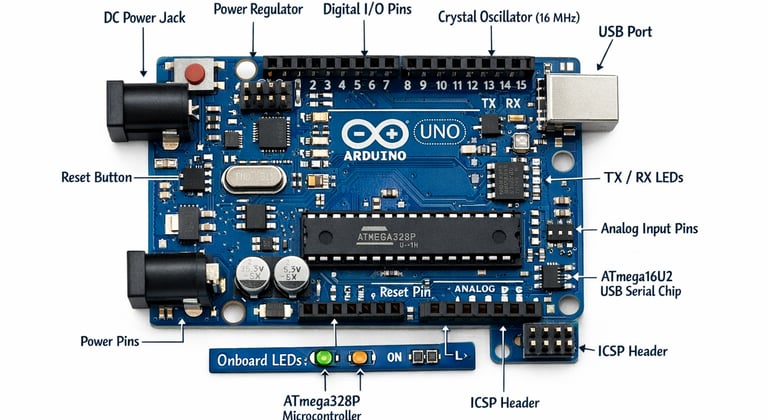
As one of the earliest and most resilient entrants in the Arduino family, the Uno became an instant classic. Its sudden dominance in the development board market can be attributed to a perfect synergy of versatile features and absolute ease of use. It removed the "high-voltage fence" of custom hardware fabrication. Here are the core components that define this foundational board:
The Brain: ATmega328P. This 8-bit micro controller is the "Heart" of the operation. It performs all the computational and arithmetic work, executing your code one line at a time with Slow and Deliberate precision.
The Bridge: USB-to-TTL Converter (ATmega16U2). This chip acts as the "Mouth", translating the high-speed USB language of your computer into the simple serial language the main micro controller understands.
The Gateway: The Boot loader. This is a tiny, persistent program pre-installed on the main chip. It gets activated whenever the board is powered up or the Reset Button is pressed. Its sole, vital job is to listen for new code arriving from the computer and upload it to the memory, allowing you to iterate on your creation in seconds.
The Pulse: Quartz Crystal Oscillator. This components provides the 16 MHz "Clock Frequency," acting as the system’s metronome to ensure every digital operation is perfectly timed.
The Power Grid. The USB Port plays dual functions: it handles data transfer and provides 5V to run the board. For standalone projects, a 7V - 12V DC Barrel Jack offers an independent, external power source.
Arduino Uno Q - The Quantum Leap
The landscape of IoT changed fundamentally with Qualcomm’s acquisition of the Arduino brand. This strategic move provided Qualcomm larger access to a vast, dedicated user base while opening the doors to a profound migration of technology between the two tech giants. The first, powerful result of this partnership is the Arduino Uno Q.
The Sovereign Brain: Qualcomm Dragon Wing QRB2210. Unlike the simple 8-bit microcontroller [cite: 2026-03-19], this is a robust, multi-core SoC (System-on-Chip). To manage this massive computational power, the Uno Q moves beyond simple code loops and operates on a full, powerful Debian Linux-based OS, bringing International Authority to the edge.
The "Internal Shield": STM32U585 Security MCU. For true Hardware Sovereignty, the Uno Q uses a dedicated STM32U585 micro controller solely for advanced security protocols [cite: 2026-01-18]. This chip generates encryption keys and provides active anti-tampering measures, ensuring your data and your device remain an untouchable sanctuary.
High-Octane Memory & Storage. The Uno Q is available in two distinct configurations, allowing for Directed Power :
Variant ABX00162: 2 GB RAM / 16 GB eMMC ROM
Variant ABX00173: 4 GB RAM / 32 GB eMMC ROM
The Industrial Nervous System. For high-fidelity connectivity, the board utilizes the WCBN3536A module, providing stable Wi-Fi 5 and integrated Bluetooth. A high-speed USB 3.0 hub expands your capacity for peripherals.
The Sovereign Power Grid. The Uno Q maintains flexibility. It runs on a standard 5V via USB-C or can handle 7V-24V through the robust DC Barrel Jack.
Conclusion: The Future is at the Edge
Whether the Arduino Uno Q will fully revolutionize the IoT landscape remains a question for the future. However, the immediate, undeniable benefit of running Edge AI and TensorFlow Lite locally is a milestone worth noting.
By removing the need for cloud integration, the Uno Q offers more than just raw power; it provides Hardware Sovereignty. In an era of data leaks and "hollow" connectivity, the ability to process intelligence within your own "Internal Shield" is the ultimate feature. The Uno Q isn't just a development board; it’s a toolkit for building a private, intelligent sanctuary.